
There is a lot of buzz around CBD oil right now. And for good reason! CBD, or Cannabidiol, oil is considered completely harmless! And not only is it harmless, it has many beneficial effects, which I will soon list.
But what exactly is CBD?
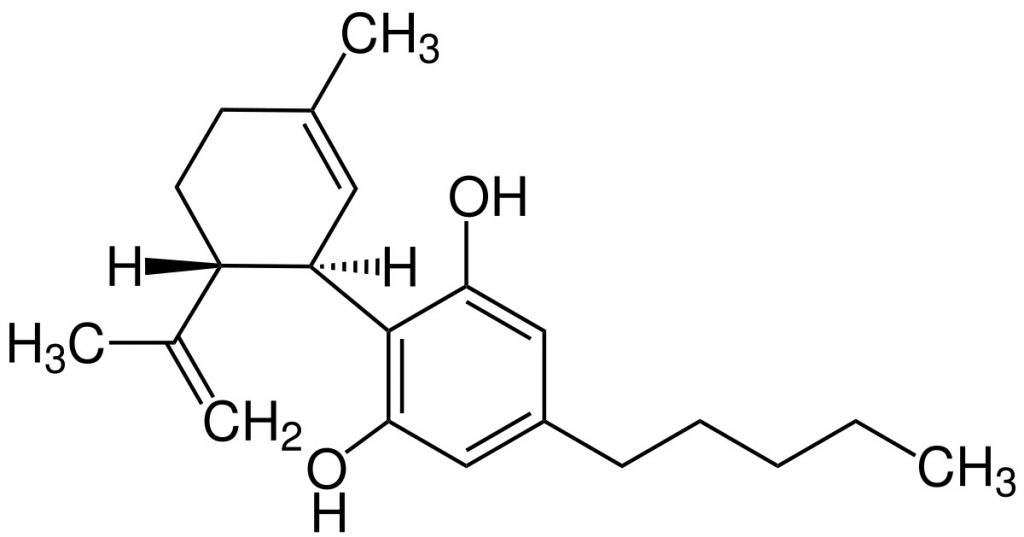
Cannabidiol, or CBD, has the chemical formula C21H30O2.
CBD (short for cannabidiol) is an active compound of the cannabis plant. It is a naturally occurring cannabinoid molecule, or phytocannabinoid, found in the largest quantities in the cannabis, or hemp, plant, but also in smaller amounts in plants like flax or azaleas. Both THC and CBD are produced in the plant’s flowers; only negligible amounts are found in the leaves, stem, and seeds.
Along with THC, CBD is the second most well-known and researched compound. Unlike THC, CBD is not psychoactive, meaning it does not get you high. This property is advantageous for patients who wish to avoid the mind-altering effects of cannabis, such as children or the elderly. CBD-rich cannabis strains and oils with significant therapeutic benefits are often referred to as “medical cannabis without the high.” Which, I might add, means exactly that!
Since this compound has no known harmful side effects, the distribution and consumption of products containing CBD are permitted in Hungary. It has no mind-altering or intoxicating effect. Instead, it possesses antispasmodic and antipsychotic properties, making it suitable for treating panic disorder, stress, epilepsy, and schizophrenia.

THC is completely extracted from CBD oil during production. This would be responsible for the intoxication, which for some reason is considered more harmful by the current legal system than alcohol-induced intoxication. (I’ve never seen a high person beat a woman, only a drunk one. Anyway…) CBD-based products can be consumed safely.
It is recommended to consume it half an hour before or after breakfast. When dropping it under the tongue, wait about 1 minute for it to be fully absorbed through the mucous membranes. If needed, take the second dose before lunch, in the same way. General experience suggests that applying small doses multiple times a day is more ideal than taking one large dose once a day. Small doses in the evening cause alertness, while large doses cause drowsiness. You need to find your own individual dose through trial and error. It can take 1-6 weeks to exert its effects, although many CBD users have reported feeling improvement even with the first dose.
Only purchase products that clearly state the active ingredient. The percentage is not important, the milligram amount is!
Therapeutic effects of CBD:
- Antiemetic (reduces nausea and vomiting)
- Anticonvulsant (suppresses seizure activity)
- Antipsychotic (fights psychotic disorders)
- Anti-inflammatory (fights inflammatory disorders)
- Antioxidant (fights neurodegenerative disorders)
- Anti-tumor/anti-cancer (fights tumors and cancer cells)
- Anxiolytic/Antidepressant (fights anxiety and depression)
- Analgesic (fights pain and pain-related disorders)
Dosing is simple: the thicker our oil, the higher its concentration, so less drops are needed than with thinner, i.e., lower concentration CBD. Always shake before use. If not dropping under the tongue, you can add it to your vape tank. However, naturally, the same type of CBD cannot be used for both; olive oil-dissolved for sublingual use, and PG-dissolved for vaping, so the source of procurement cannot be the same webshop, but Google is good for this too. The general recommendation is 1 drop per 10 kilograms of body weight!
CBD helps with many things:
- It has antibacterial effects
- It stops the proliferation of cancer cells
- It protects nerve receptors
- It aids bone development
- It reduces seizures and spasms
- It lowers blood sugar
- It reduces the immune system’s reaction – helps with autoimmune diseases
- It reduces the risk of heart attack
- It reduces intestinal contractions
- It prevents vomiting and nausea
- It helps with pain
- It helps with anxiety
- It inhibits muscle spasms
- It calms the nervous system, alleviates psoriasis
However, CBD oils may contain trace amounts of CBGA, CBG, and CBDA. And yes, sometimes they also contain THC, which is legal up to a concentration of 0.2%. And naturally, these substances also have only positive effects.
CBGA:
- Reduces inflammation
- Reduces pain
- Slows bacterial growth
CBG:
- Aids sleep
- Prevents the formation of cancer cells
- Promotes bone growth
- Slows bacterial growth
CBDA:
- Reduces inflammation
- Prevents the formation of cancer cells
THC:
- Relieves pain
- Helps with nausea and vomiting
- Stimulates appetite
- Inhibits muscle contractions (spasms)
The WHO (World Health Organization) has published a list of diseases for which CBD may have therapeutic benefits. This comes from research published in the scientific journal Pharmacology & Therapeutics. CBD is recommended for those suffering from the following conditions:
- Alzheimer’s disease
- Parkinson’s disease
- Multiple sclerosis
- Huntington’s disease
- Ischemic-hypoxic injury
- Pain
- Psychosis
- Anxiety
- Depression
- Cancer
- Nausea
- Inflammatory diseases
- Rheumatoid arthritis
- Infection
- Inflammatory bowel and Crohn’s disease
- Cardiovascular diseases and
- Diabetic complications
CBD oil is considered a dietary supplement, and its effectiveness largely depends on the human body, so dosage descriptions may vary from person to person.
There is also CBD e-liquid, which is flavored. It contains all the goodness, just in lower concentrations. These are nicotine-free. But for those who don’t want to drip or vape, it is also available in gel capsule form, and there is also a topical cream, but be careful with that, as it cannot be applied to damaged skin!
For my part, I have decided to try one of its forms; it won’t hurt, as it is impossible to overdose; if I were to consume too much, I would just get sleepy. That’s all…
Cover image: observer.com

 A CBD-t mikor használtam a hajhullás is csökkent pár nap után.
  A váll és lábfájdalmamat csillapította,meg bealudtam tölle
 Csak így tovább, és minden rendben lesz.


 Drukkolok, mert nagyon rossz az a betegség. Sajnálom.
 De a lényeg asszem ennyi.